
Current Drive for Better Sound
The amplifier holds the current through the voice coil, not the voltage across it. What changes is not the THD number — it is the shape of the harmonic spectrum.
Nearly every amplifier ever built is a voltage source: its output impedance is close to zero, and it holds the voltage across the speaker terminals to the signal no matter what the driver does. A current drive amplifier does the opposite. Its output impedance is high compared with the loudspeaker — ten times the driver’s impedance or more — so what follows the signal is the current through the voice coil.
Such amplifiers are almost non-existent in audio. First Watt’s F1 and F2 are the best-known commercial examples, and they have a devoted following. It is not a universal upgrade: driving a box speaker through a passive crossover, current drive can do more harm than good, because a passive crossover is designed around being fed from a voltage source and the driver loses its electrical damping at resonance. Driving a naked driver in an active open-baffle system — one amplifier channel per driver, no passive filters — it is close to ideal.
THD is the wrong number to look at
Both spectra below are the same Visaton BG20 fullrange driver, the same 1 kHz tone at the same acoustic level (81.9 vs 81.6 dB RMS), measured through a microphone rather than into a resistor. The only difference is how the amplifier drives it.
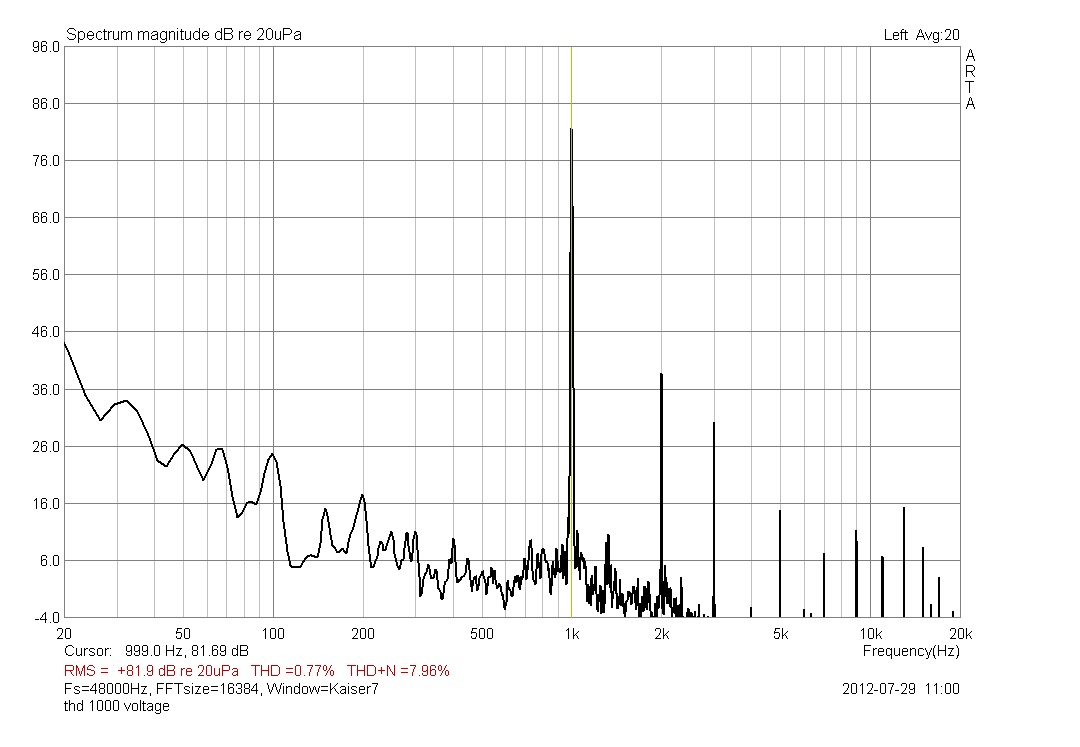
Pic. 1 — Voltage drive. THD 0.77 %. Note how the harmonic series keeps going: 2 kHz, 3 kHz, then a comb of higher-order products all the way out to 18 kHz.
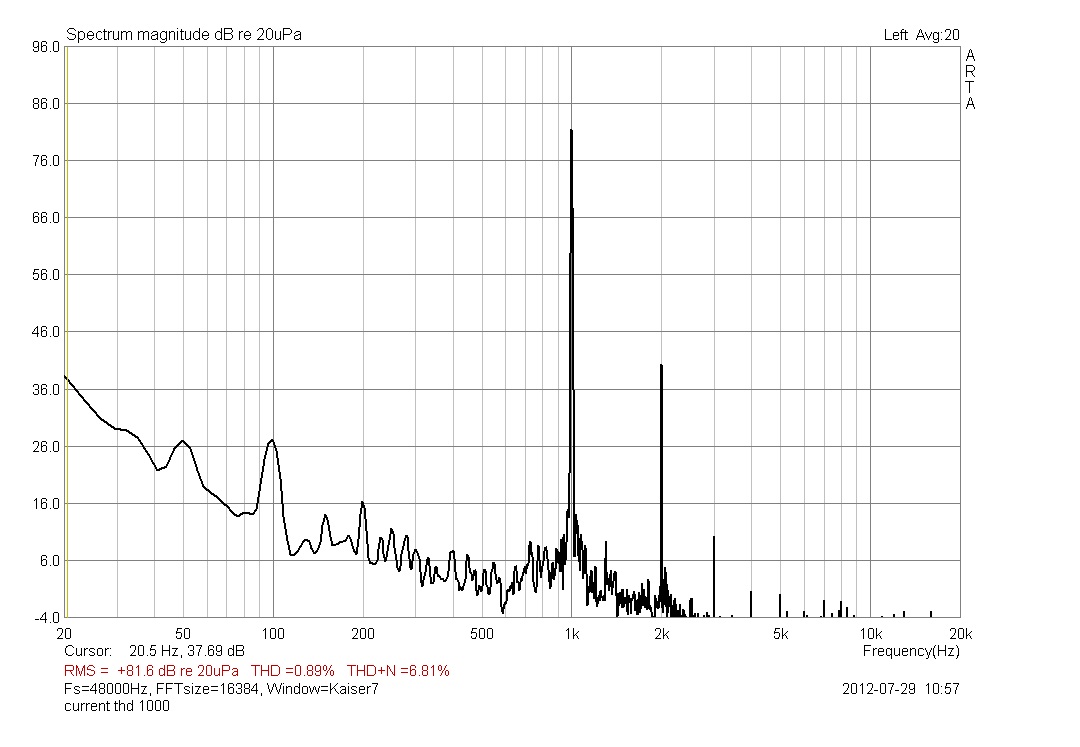
Pic. 2 — Current drive, same driver and same level. THD 0.89 %: numerically worse, audibly the opposite.
On paper voltage drive wins — 0.77 % against 0.89 %. In the spectra the ranking reverses. Under current drive the second harmonic is essentially unchanged, a decibel or so higher, which is precisely why the THD figure went up. The third harmonic drops by roughly 20 dB, and above 4 kHz the harmonic comb all but disappears.
THD is a single number dominated by the largest component, and the largest component is the second harmonic — the one current drive does not remove and the one the ear minds least. It sits an octave above the fundamental, is strongly masked by it, and is musically consonant. The high-order harmonics that current drive does remove are the opposite case: far enough from the fundamental to escape its masking, dense enough to fall in several critical bands at once, and concentrated exactly where hearing is most sensitive. That is the part you hear as hardness and listening fatigue, and it is the part that a THD figure barely registers.
The same result on a different driver
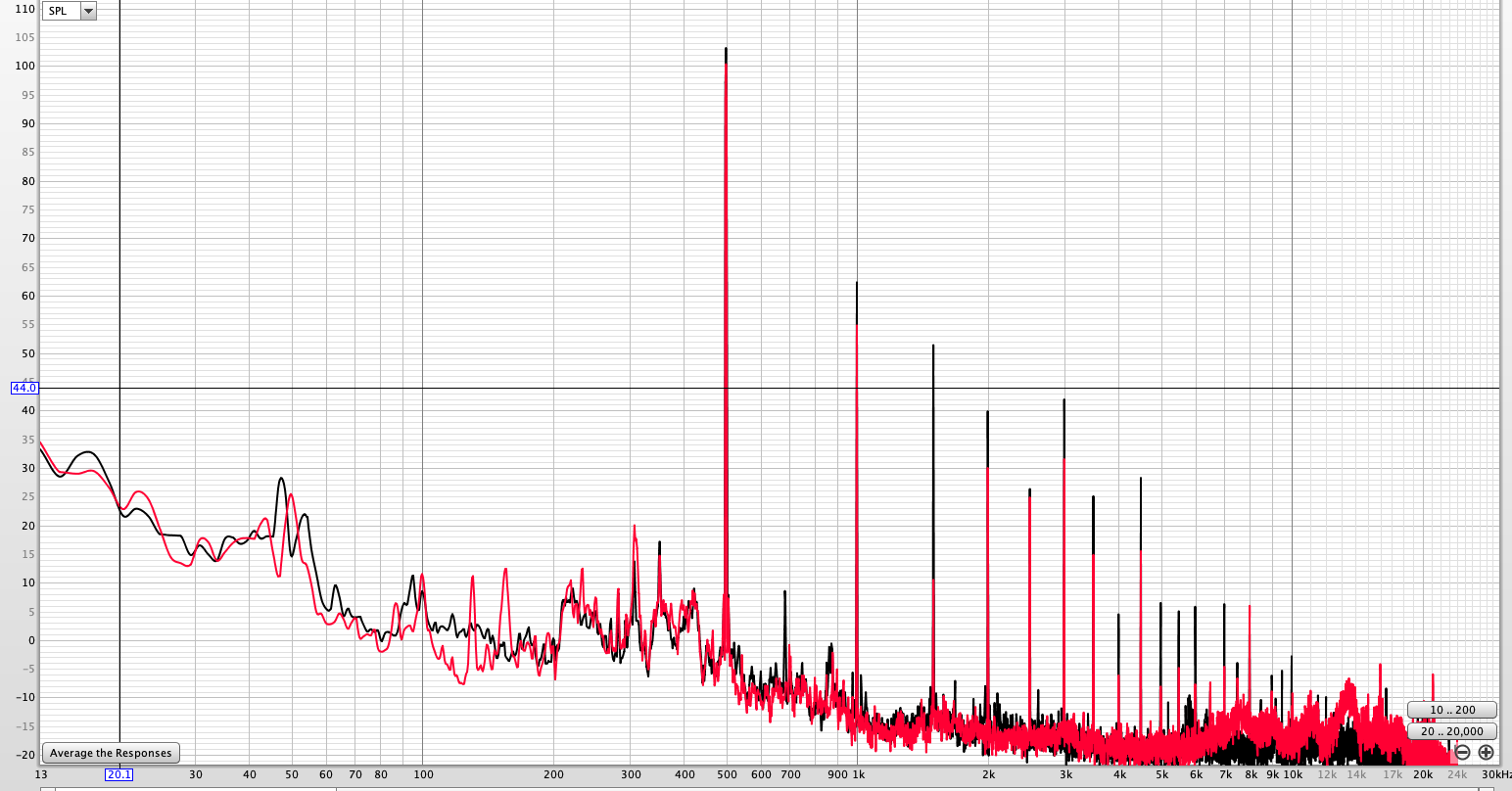
Pic. 3 — SEAS FA22RCZ fullrange, current drive (red) overlaid on voltage drive (black), tone near 490 Hz at about 103 dB. The second harmonic tracks within a few dB; the third, near 1.5 kHz, falls from about 51 dB to about 11 dB.
The pattern repeats on a completely different driver. The fundamental and the second harmonic are almost on top of each other; from the third harmonic upwards the black voltage-drive trace stands consistently above the red one, typically by 10 dB and in the case of the third harmonic by around 40 dB. Same conclusion, and again the summed THD figure hides it.
Why valve amplifiers have been doing this by accident
A valve amplifier with modest feedback has a relatively high output impedance, so it operates part-way between voltage and current drive. Part of its reputation for sounding “pleasant” comes from exactly this mechanism: the driver connected to it produces fewer high-order harmonics. Current drive takes the same effect to its limit, without the rest of the valve amplifier’s compromises. With the high-order products gone, the result is more air, more lifelike, cleaner — a more relaxed listen rather than a more impressive one.
At the driver’s resonance, voltage drive is slightly cleaner, which is why the Baffless amplifier is mixed-mode by design: voltage drive at low frequencies, current drive higher up, with a jumper selecting voltage mode, mixed mode 1 or mixed mode 2. You get the damping where the driver needs it and the clean spectrum everywhere else.
Read more about current drive
Outside this site, the deepest resource on the subject is current-drive.info. The founding paper is older still: P. G. L. Mills and M. O. J. Hawksford, Distortion Reduction in Moving-Coil Loudspeaker Systems Using Current-Drive Technology, Journal of the Audio Engineering Society, vol. 37 no. 3, March 1989. The physics has been settled for over thirty years; what is missing is adoption.