Analog current drive amplifier
A stereo board with balanced inputs. Mixed-mode current drive, so the loudspeaker driver distorts less.
Assembled and tested, with mounting brackets. Shipping from the EU is extra. You still need a heatsink and a power supply.
Overview
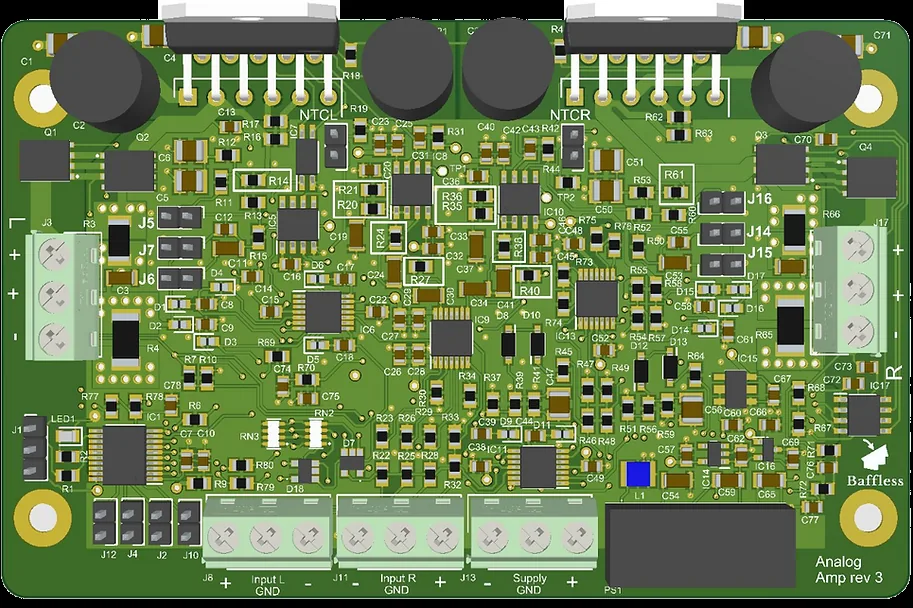
A mixed-mode current drive board.
This is a stereo board with balanced inputs. It suits full-range systems especially well. You can run it without DSP, but I would not: the onboard analog input filter is less precise and takes real work to tune. Input sensitivity and filter values are set by soldering resistors.
The job of current drive is to cut distortion in the loudspeaker driver. The idea is old, but outside DIY it is still rare. Current drive is not ideal at the driver’s resonance, so this amplifier is mixed-mode by design: voltage drive at low frequency, current drive at high frequency. A jumper selects voltage amp, mixed mode 1, or mixed mode 2.
In current mode, voltage controls output current, so the output voltage depends on the load. To keep mixed-mode response reasonably flat, the front end trims gain and filter shape for the driver — again by soldering, with no DSP. The board is meant for a naked driver in an active system, with no passive filters. Multi-driver passive speakers will work, but you lose some of the current-drive benefit.
Turn-on and turn-off are silent: the board comes up and down with the supply. The same circuit also flags a supply fault or a sudden voltage sag.
Amplifier has 3 modes:
- Voltage amp
- Mixed mode 1
- Mixed mode 2
Amplifier has several protection features:
- Clip protection
- Fast overcurrent protection
- DC protection
- Over temperature protection
The power stage is an LM3886 in a composite setup, with a second layer of overcurrent and over-temperature protection. Some of those functions can be jumpered. The board is designed for a switching supply. A toroidal supply can sag enough to trip protection; you can disable some of that, but this amplifier was not designed around a transformer PSU.
The complete user manual, with all technical information, is here.
Advantages of current drive
Open, real, involving.
Equalised to the same response, voltage drive and current drive still sound different. Fair A/B is hard, so I built a DEV amp that switches modes from a phone. The sound opens up: more real, more involving. Most of the difference is in small, subtle details. On voltage drive those sounds are there, but damped, as if behind a thin filter. On current drive they simply appear. It is a more relaxed, natural listen — like taking the back off a box speaker and hearing open baffle.
Current drive is not a drop-in upgrade for speakers designed around voltage drive. For a new system I would not build it any other way. I have used this for 15 years. Tube amplifiers sit somewhere between voltage and current; some Nelson Pass designs also run high output impedance.
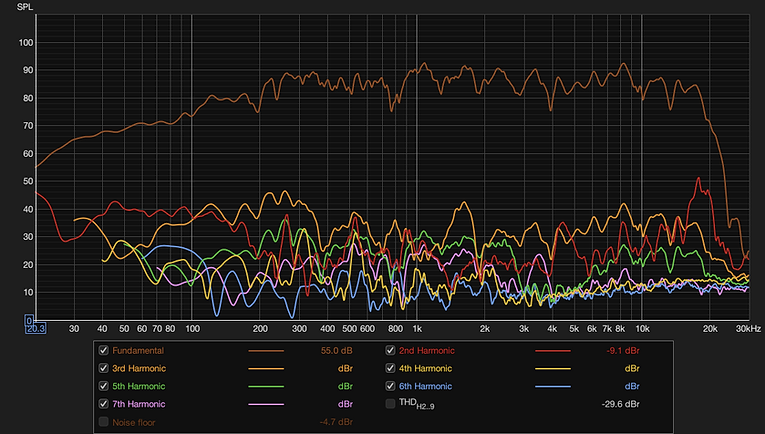
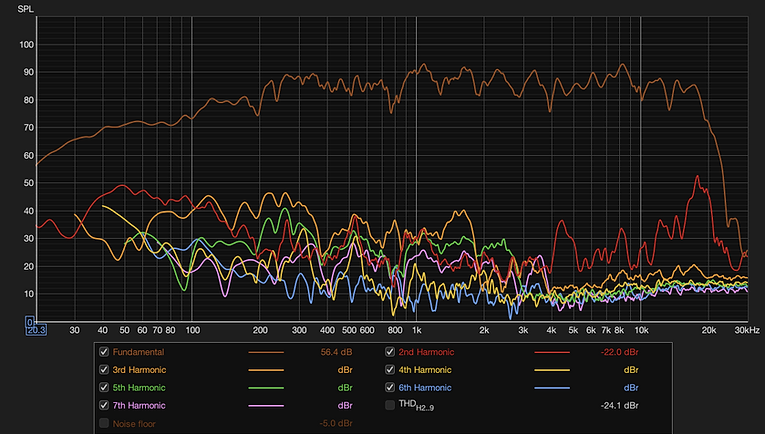
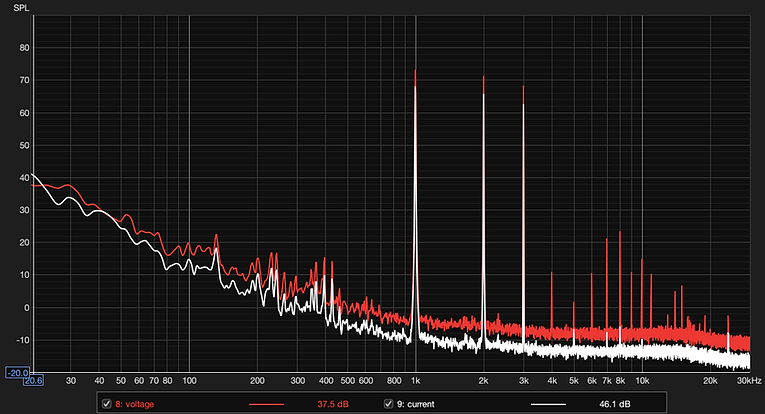
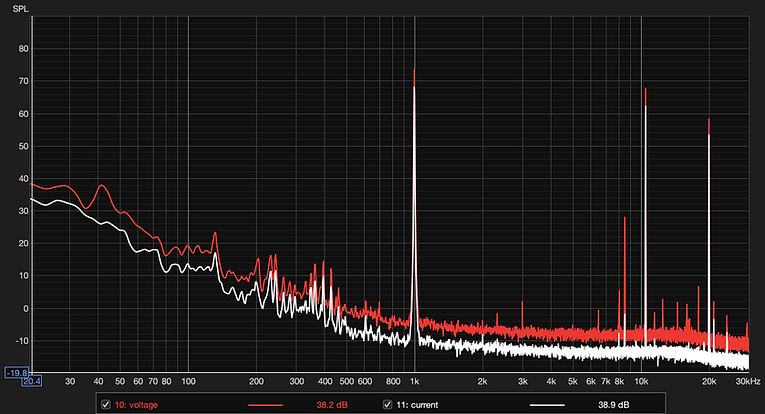
The measurements agree: 10 dB less THD is common, often more. Good drivers already sit around −50 to −60 dB, so that is a large step, and it hits the distortion you actually hear. Another interesting paper about current drive here.
Measurements
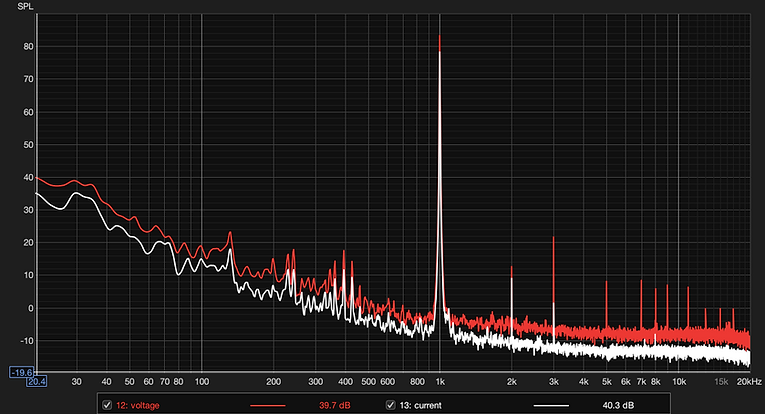
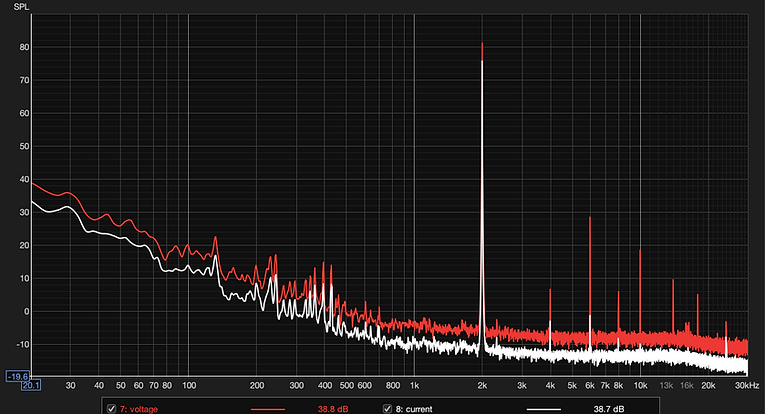
Visaton BG20 fullrange, 94 dB at 1 m. The 3rd harmonic drops the most. Near resonance, voltage drive is slightly cleaner — which is why this amplifier is mixed-mode. These plots are full voltage versus full current, not mixed-mode. Harmonics sit at their true frequencies, so a 1 kHz tone’s 3rd harmonic is at 3 kHz. Above 2 kHz the spectrum is much cleaner.