
Single Speaker Stereo — Wiring, Mid/Side and Streaming
How the three drivers are actually connected, why the mid/side gain is frequency dependent, and how the digital chain was verified.
This page documents the engineering behind the Single Speaker Stereo build: the driver connection, the mid/side processing, the amplifier that drives it and the streaming chain feeding it. It describes the earlier complete SSS system, which is now a development path rather than a standard product.
Driver Connection
The three full-range drivers are not wired in the usual star arrangement. They sit in a delta arrangement between two amplifier channels: the left driver on one channel, the right/inverted driver on the other, and the front driver bridged between the two amplifier outputs through a series resistor.

The delta connection used inside the Single Speaker Stereo. A star connection cannot be used here, because the amplifiers are floating-load designs with no common return.
The connection is less simple than the drawing suggests. The amplifiers are current amplifiers whose output impedance varies with frequency, so the front driver's series resistor is chosen to bring all three drivers to roughly equal output for a centre-panned signal. With centred content the loudspeaker therefore behaves as a monopole radiating about equally to the front, left and right.
Two things follow from that. The sound is spread more evenly across the room, and the power response improves: the balance of highs and lows measured at the centre seat is close to the balance at the extreme left and right seats.
Beam Steering and Mid/Side Gain
The delta connection is what produces the beam steering effect. On top of it, mid/side stereo coding is used to raise the gain of the side signal.
That lift is adjustable, because the right amount depends on the room's acoustics and dimensions. The reasoning is straightforward: side information leaves the lateral drivers, travels a longer path to the listener and loses some energy into the wall it reflects from. Restoring it has a very positive effect on the listening experience. The lift is also applied by different amounts at different frequencies, so the complete scheme is considerably more involved than a single side-gain control.
The Amplifier
The SSS is driven by Baffless amplifiers, which are a subject in themselves. DAC and amplifier live on one board, and that integration is the point.
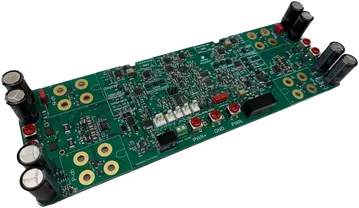
The Baffless amplifier board that drives the Single Speaker Stereo: DAC and both amplifier channels on a single PCB.
Measured: noise floor below −120 dB and THD in the 0.000x % range — at that level the measurement equipment is currently the limiting factor, not the board.
The board carries an integrated Sabre DAC and is fully galvanically isolated from both the digital source and the standby supply. It has clipping and DC protection, automatic power on/off and click-free switching. The output transistors are rated at 900 W short-term and need no electrical isolation pads, which makes mounting simpler and more reliable.
The same amplifier can be configured as a voltage amplifier, a current amplifier or a mixed-mode amplifier. In the SSS it runs mixed mode: voltage drive at low frequencies, current drive above. Distortion produced by a loudspeaker driver is far larger than the distortion of the amplifier feeding it, so it is worth using the amplifier to bring the driver's distortion down. The result is a more open, more life-like sound. The measurements behind that are on the current drive vs voltage drive page, and also on the analog current-drive amplifier page.
Streaming
The speaker offers three streaming paths, added in this order and for these reasons.
AirPlay came first because it simply works from Apple devices: no setup, reliable, user friendly. Roon came second because it is of higher quality. Roon streams over its own RAAT protocol, which supports higher sample rates and bit depths than AirPlay's CD-quality 44.1 kHz / 16-bit, and works from the audio backend's clock, sending data when the backend asks for it — so in theory it can run with no resampling at all. DLNA came third: Roon is excellent but an expensive application, and Android users have no AirPlay.
Verifying the Digital Chain
Many people assume the digital part is always correct — that streaming 96 kHz / 24-bit means 96 kHz / 24-bit arrives at the DAC. Very often it does not. There are several processes in between, settings may not be optimal and code can have bugs.
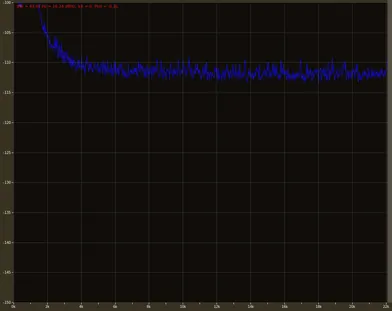
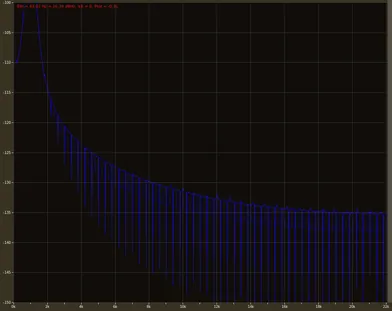
Long-term peak-hold spectra of a 1 kHz tone: AirPlay (left) and Roon (right). The 16-bit AirPlay path settles near −112 dBFS; the RAAT path sits roughly 20 dB lower, which is the bit depth difference showing up as measured noise floor.
So the chain is checked rather than assumed. Each link is measured by looking at the spectrum and running long-term peak-hold metering, as above.
There is also a purpose-made test file in which every sample holds the same bits. With that file playing, the I2S line at the DAC can be read directly on a scope: the actual word length is visible — 16, 24 or 32 bits — along with how the most and least significant bits behave, and any problem in between shows up immediately. Because the Baffless amplifier is fully DC coupled, that same file also turns it into an adjustable DC voltage or current source.