
Dipole System
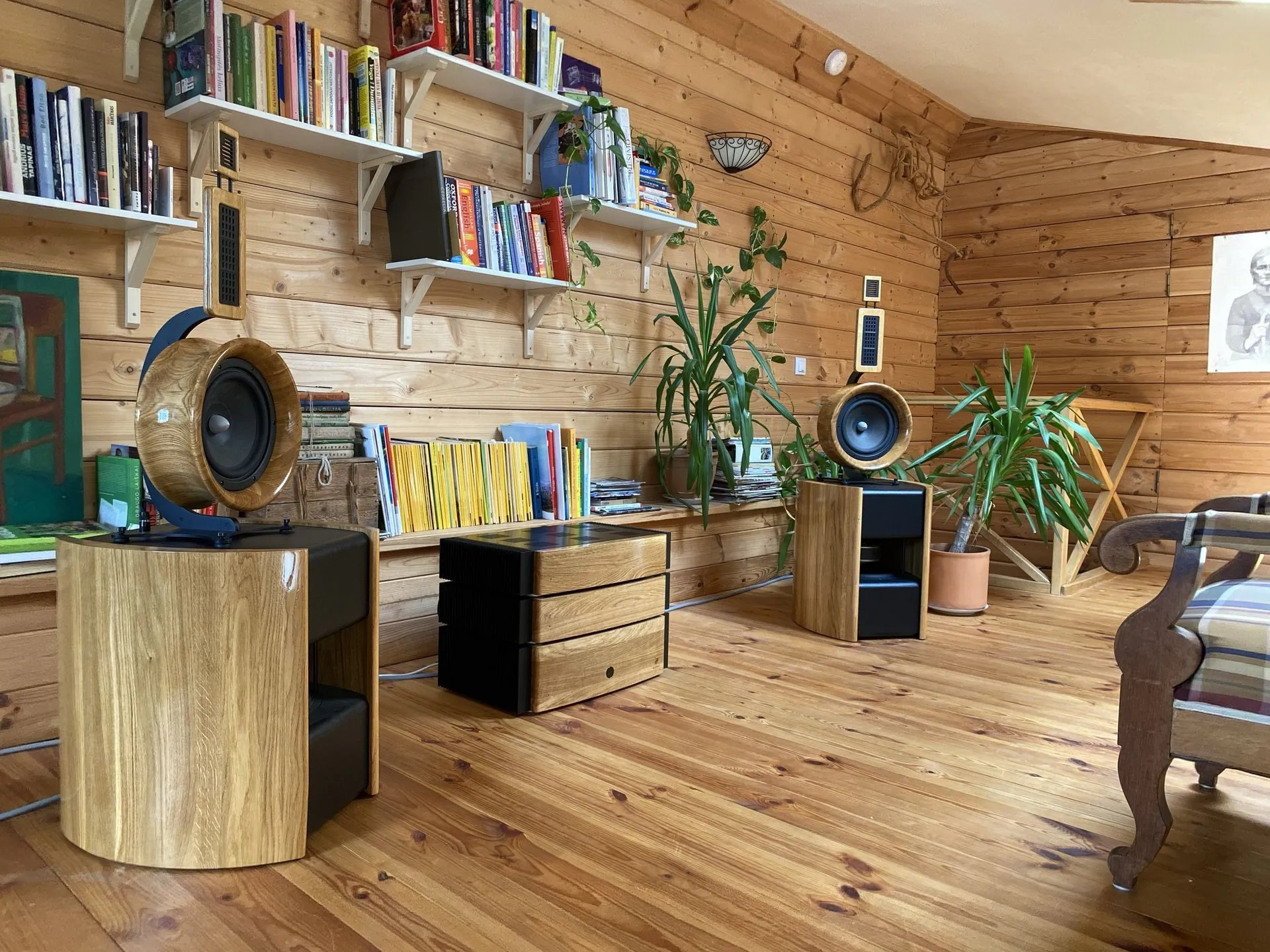
The Baffless Dipole System is an active four-way loudspeaker without a box. Every driver works as a true dipole from 20 Hz to 20 kHz: it radiates equally forwards and backwards and almost nothing to the sides.
What it is
Each driver sits on the smallest baffle that still does its job, in a solid hardwood frame. A DSP crossover splits the signal at 170, 800 and 3000 Hz with 48 dB/octave linear-phase FIR filters, so each driver plays only around its first dipole peak — the range where its baffle is still small compared with the wavelength and the driver behaves as one compact point source. The drivers are then aligned from acoustic measurements of the finished loudspeaker, not only from an electrical schematic.
The system is designed and built by one person, Rytis Smolskas, in Vilnius, Lithuania.
Why a dipole
In a room you hear the direct sound plus its reflections from the walls, floor and ceiling. Research by Floyd Toole, Sean Olive and others found that listeners prefer loudspeakers whose off-axis sound has the same spectral balance as the on-axis sound. A box loudspeaker radiates in all directions at low frequencies and becomes directional only higher up, so its reflections are a coloured copy of the direct sound.
A dipole keeps the same figure-of-eight pattern as frequency rises. Measured in free field, the directivity index of the Baffless system stays between 4.6 and 6.3 dB from 20 Hz to 5 kHz; a textbook dipole is 4.8 dB. The deep nulls at ±90° send less sound towards the side walls, so fewer side reflections reach the listener. The full polar measurements are on Dipole All The Way.
What is in the system
- Open-baffle dipole radiation in all four bands, 20 Hz–20 kHz.
- Active four-way FIR crossover with constant group delay through each transition — see Seamless Crossover and Flat Frequency & Phase.
- Current-drive amplification, which controls voice-coil current instead of voltage — see What Is a Current-Drive Amplifier?
- Crosstalk cancellation for a more focused centre image, where vocals usually sit.
- Equal-loudness compensation tied to the volume control, so bass does not disappear at low volume — see Integrated Equal Loudness Control.
- Minimal cabinet coloration: minimal baffle area, solid hardwood and sorbothane decoupling of each driver.
- One integrated system: DSP, amplifiers, DAC and streaming are designed together — see All-In-One System.
Trade-offs
At low frequencies the front and rear waves of a dipole partly cancel each other. Dipole bass therefore needs more driver excursion and amplifier power, and the maximum sound level is lower than from a comparable box loudspeaker. In small and medium rooms this matters little, and there dipole bass sounds cleaner and more articulated, because the side nulls excite fewer room modes and reflections.
A dipole is also not the most directional loudspeaker possible. Its directivity index is about 4.8 dB, and its rear wave is as loud as the front one, so that sound still reaches the listener after reflecting from the wall behind the loudspeaker. Cardioid and hypercardioid designs reach about 6 dB, horns and large arrays 10 dB or more. For stereo in a normal room the dipole is a good balance. For reproducing binaural recordings through loudspeakers with full crosstalk cancellation it is not the ideal: every reflection carries crosstalk that the filters cannot remove, so there the most directional loudspeaker, with the highest directivity index, in a well-damped room makes more sense. The crosstalk cancellation in this system is aimed at a more focused stereo image, not at full binaural playback.
Contact
To discuss the system, write to smolskas.rytis@baffless.com.